Customs and Border Protection Officer Requirements
Updated September 25, 2026
Becoming a Customs and Border Protection Officer means clearing a federal hiring process with two entry paths: qualifying education or experience at GS-5, or graduate-level education or specialized experience at GS-7. Both paths lead to 103 days of training at the Federal Law Enforcement Training Centers (FLETC) in Glynco, Georgia, before you complete the academy and begin full duties.
CBP Officers work the country’s ports of entry, airports, land crossings, and seaports, screening the people and cargo trying to cross the border. You’re the one deciding who and what gets in, which means the job comes with a named entrance exam, a background investigation, and a hiring process built to weed out anyone who can’t handle that responsibility.


What Does a CBP Officer Do Day-to-Day?
You’ll inspect belongings, question travelers, and look for the signs that separate a nervous flier from a smuggler. Part of the job is learning how human traffickers and narcotics dealers operate, so you can spot the pattern before the person is standing in front of you.
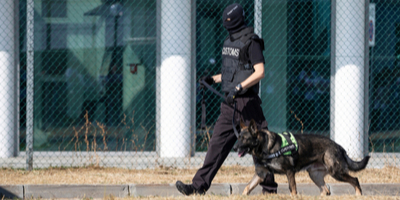
The work splits by location, but always at an official port of entry. At a land-border crossing, you’re inspecting vehicles and questioning drivers and passengers before they’re admitted into the country. At an airport or seaport, you’re checking passports and cargo manifests, verifying that what’s declared matches what’s actually in the container or bag. Patrolling the area between official crossings is the Border Patrol Agent’s job, a related but separate role covered in the FAQ below. Some CBP Officers become trained canine handlers, working detection dogs specifically for narcotics and contraband.
You’ll be on your feet for a full shift, and the Fitness Test during hiring exists because the job sometimes requires you to restrain someone or move fast in tight quarters. Prepare for that before you apply, not after.
What Are the Requirements to Become a CBP Officer?
CBP requires applicants to meet one of two entry paths, pass a named entrance exam, and clear a background investigation before your General Service (GS) grade level is set.
| Entry Level | Education Path | Experience Alternative |
|---|---|---|
| GS-5 | Bachelor’s degree, any field, from an accredited institution | 3 years of general experience, including at least 1 year equivalent to GS-4, working with the public and applying learned procedures |
| GS-7 | Bachelor’s degree with Superior Academic Achievement, or 1 full year of graduate-level education | Qualifying specialized experience inspecting people, documents, or goods, or applying laws and regulations in ways that can lead to arrests, seizures, or penalties |
Every applicant, regardless of grade level, must pass the CBP Officer Entrance Exam, a required pre-employment test that’s more specific than most of the other qualifying language on this page. You can also mix education and experience to meet either grade level’s minimum, and a degree in criminal justice, homeland security, or a related field gives you an edge in a competitive applicant pool even though it isn’t required.
Once you accept a position, you’ll sit for the pre-employment Fitness Test and go through a Tier 5 national-security background investigation, the level required for Critical-Sensitive/High-Risk federal positions. Most applicants also need a favorable polygraph, though CBP may accept a prior federal polygraph result, and some veterans qualify for a waiver.
From there, you report to FLETC in Glynco, Georgia, for 103 days of training, split between physical work (exercise, scenario-based drills, passenger processing) and classroom instruction in Title 19 Customs law and Title 8 Immigration law, the two bodies of law you’ll enforce every shift you work.
At the final-offer stage, CBP asks you to choose from the duty stations available at that time. The agency tries to honor your earlier preferences, but availability shifts, so the post you wanted during the application isn’t guaranteed to be still open when you’re offered the job.
How Much Do CBP Officers Earn?
As of the 2025 BLS wage data, the national median annual wage for Detectives and Criminal Investigators (the closest classified occupation to CBP’s mission, since BLS doesn’t break out a CBP-specific wage line) was $93,790. That figure covers detectives and investigators across local, state, and federal agencies, not CBP specifically, so treat it as a benchmark rather than an exact number for this job. Your actual pay follows the federal GS pay scale for your grade and locality, which you can look up directly on OPM’s current pay tables.
Nationally, employment in this occupation is projected to remain nearly flat between 2025 and 2035, per BLS Employment Projections. That’s not a red flag specific to CBP: hiring at any individual agency depends on its own budget and staffing needs in a given year, which a broad occupational code can’t capture.
CBP Officers regularly work alongside the Drug Enforcement Administration, the FBI, and other federal agencies, and get pulled into joint investigations and assignments outside their home station. In April 2018, CBP officers at Arizona’s Port of San Luis seized roughly $623,000 worth of methamphetamine and heroin across three separate smuggling attempts over three days, the kind of case that shows up on a slow shift and changes everything about it.
May 2025 US Bureau of Labor Statistics salary figures for Detectives and Criminal Investigators. National (2025-35) job growth projections from the US Bureau of Labor Statistics Occupational Outlook Handbook. Figures reflect national data, not school-specific information. Conditions in your area may vary. Data accessed September 2026.
Frequently Asked Questions
What are the requirements to become a CBP officer?
You need either a bachelor’s degree or qualifying experience for GS-5, or a bachelor’s degree with Superior Academic Achievement (or a year of graduate-level education) for GS-7. Every applicant must also pass the CBP Officer Entrance Exam, the pre-employment Fitness Test, a Tier 5 national-security background investigation, and, in most cases, a polygraph.
Do you need a college degree to become a CBP officer?
No. You can qualify for GS-5 with three years of general experience instead of a degree, or for GS-7 with a year of specialized experience inspecting people, documents, or goods. A degree helps in a competitive applicant pool, and Superior Academic Achievement can qualify you for GS-7 on its own, but CBP doesn’t require a degree at the entry level.
How long is CBP Officer training?
Training at the Federal Law Enforcement Training Centers in Glynco, Georgia runs 103 days. You’ll split time between physical training and classroom instruction in customs and immigration law before completing the academy and beginning full CBP Officer duties.
How much does a CBP officer make?
BLS doesn’t publish a CBP-specific wage line. The closest classified occupation, Detectives and Criminal Investigators, had a national median wage of $93,790 as of May 2025 BLS wage data. Your actual CBP pay follows the federal GS scale for your grade and duty station, not this figure directly.
What’s the difference between a CBP officer and a Border Patrol agent?
CBP Officers work official ports of entry, airports, land crossings, and seaports, inspecting travelers and cargo presenting themselves for legal entry. Border Patrol Agents patrol the area between official ports of entry, watching for people crossing outside a checkpoint. Both fall under CBP, but they’re different jobs with different hiring tracks. If you’re weighing federal immigration roles more broadly, our guide on how to become a USCIS immigration officer covers a related but separate agency.
Key Takeaways
- Two entry paths: GS-5 with a bachelor’s degree or qualifying experience; GS-7 with Superior Academic Achievement, a year of graduate education, or specialized inspection experience.
- Training is 103 days at FLETC in Glynco, Georgia, split between physical drills and Title 19/Title 8 law instruction.
- You choose your duty station at the final-offer stage, from whatever CBP has available then, not necessarily your first choice.
- Screening includes a named entrance exam, a Fitness Test, and a Tier 5 background investigation, not a blanket “high security clearance.”
- The $93,790 median wage is a benchmark, not a CBP figure — actual pay follows the federal GS scale for your grade and locality.
If cost is what’s holding you back, our scholarships page lists what’s currently open to criminal justice students, with eligibility, amounts, and deadlines.