
Deputy US Marshal
Updated October 9, 2026
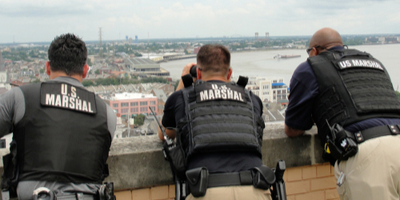
A deputy US marshal is a federal law enforcement officer who protects federal courts, transports prisoners, and hunts fugitives for the US Marshals Service, the country’s oldest federal law enforcement agency. Expect a bachelor’s degree or equivalent law enforcement experience, a demanding background investigation, and 17.5 weeks of training at the Federal Law Enforcement Training Center (FLETC) in Glynco, Georgia.
The US Marshals Service has been the enforcement arm of the federal courts since 1789, and the job hasn’t changed as much as you’d think: find people who don’t want to be found, and keep the courtroom secure while the case against them plays out. You’ll work under a presidentially appointed US marshal in one of the agency’s 94 federal judicial districts, rotating between courtroom security, prisoner transport, and fugitive work depending on what your district needs that week. Here’s what it actually takes to earn the star.


What Does a Deputy US Marshal Do?
The agency breaks a deputy’s duties into seven main areas: witness security, judicial security, fugitive investigations, prisoner transport, prisoner services, asset forfeiture, and special missions. In practice, that means you could be guarding a federal judge in the morning and transporting a prisoner between facilities by afternoon.
Firearms proficiency isn’t optional here. You’re carrying a weapon into federal courtrooms and prisoner transport vehicles, and apprehending people who don’t want to be arrested, so you’ll requalify on the range on a fixed schedule for as long as you carry the badge. Physical fitness works the same way. It isn’t a one-time test you pass and forget.
How Do You Become a Deputy US Marshal?
You can qualify through education or experience, and the US Marshals Service lays out both paths in its hiring requirements. Plenty of deputies come up through patrol work first, so it’s worth seeing how to become a police officer or what a police detective actually does before deciding whether to start locally or go federal first.
Education Requirements
To qualify at the GS-07 level through education, you need a bachelor’s degree in any field, plus one of three markers of strong academic performance: a 3.0 GPA or better, a class rank in the top third, or membership in a national scholastic honor society. You’ll also need one year of graduate school in a related field, such as sociology, criminal justice, or law.
Work Experience
No degree? You can still qualify with one year of specialized experience in investigation, arrest procedures, firearms use, or serving court orders. Law enforcement or military service usually covers this. Most applicants end up stacking a mix of education and experience rather than relying on either alone.
Training Requirements
Once you’re hired, you report to FLETC in Glynco, Georgia, for 17.5 weeks. Training covers court security, defensive tactics, physical conditioning, firearms, search and seizure, and building entry. You’ll sit for seven exams and need at least 70% on each one, plus pass/fail practical exercises in surveillance, high-threat trials, and officer survival. Washing out of a single exam or practical can end your appointment before it starts.
Deputy US Marshal Salary and Job Outlook
Deputies are paid on the federal general schedule law enforcement (GL) pay scale, and current hiring announcements on USMS’s own careers page list the exact entry-level step for open positions, plus locality pay for your duty station. The closest national benchmark BLS tracks for this kind of work is detectives and criminal investigators, which had a median annual wage of $93,790 as of May 2025.
Job growth for that same group is essentially flat. BLS projects national employment for detectives and criminal investigators to go from 120,500 to 120,700 positions between 2025 and 2035, a 0% change. That doesn’t mean openings dry up. Deputies retire, transfer, and leave the field at a steady rate, so the agency still runs regular hiring cycles even in a year with no net growth.
May 2025 US Bureau of Labor Statistics salary and 2025–35 job growth projections for detectives and criminal investigators, the closest tracked occupation to this role. Figures reflect national data, not school-specific information. Conditions in your area may vary. Data accessed October 2026.
Frequently Asked Questions
What’s the difference between a deputy U.S. Marshal and a U.S. Marshal?
A U.S. Marshal is the presidentially appointed, Senate-confirmed head of one of the agency’s 94 federal judicial districts. Deputy US marshals are the career law enforcement officers who carry out the agency’s day-to-day missions within that marshal’s district.
Do you need a college degree to become a deputy US marshal?
Not necessarily. You can qualify through a bachelor’s degree with strong academic standing, or through one year of specialized law enforcement or military experience. A degree in criminal justice, law enforcement, or a related field still gives you an edge in a competitive hiring process.
How much does a deputy U.S. Marshal make?
Deputies are paid on the federal GL law enforcement pay scale, with the exact starting step and locality pay listed on current USMS job announcements. The closest BLS benchmark, detectives and criminal investigators, had a median annual wage of $93,790 in May 2025.
How long is deputy U.S. Marshal training?
Training runs 17.5 weeks at FLETC in Glynco, Georgia, and covers firearms, defensive tactics, court security, and physical conditioning. You’ll need a passing score on seven written exams plus pass/fail practical exercises to complete the program.
Key Takeaways
- The hiring bar has two doors: a bachelor’s degree with strong academic performance, or one year of specialized law enforcement or military experience.
- Training is 17.5 weeks at FLETC in Glynco, Georgia, with seven exams you need to pass at 70% or better, plus hands-on practical tests.
- The job covers seven mission areas, from judicial security to fugitive investigations, so no two weeks look exactly alike.
- Pay runs on the federal GL scale, not a standard civilian pay table, so check current USMS job postings for the real starting number in your district.
The background check and the GS-07 bar are the real gate here. Every deputy goes through the same seven exams and 17.5 weeks at FLETC, no matter which district they end up serving, so treat the application process itself as the first test.